The 2026 tent market is weirdly split. On one side you've got the instant-cabin crowd that wants stand-up height and a 90-second setup, and on the other you've got the ultralight purists who think a 4-pound shelter is a luxury resort.
I've spent the last few months bouncing between both worlds, testing six tents that kept showing up in buyer reviews as either "best thing I ever bought" or "leaked on night one." Usually both, somehow.
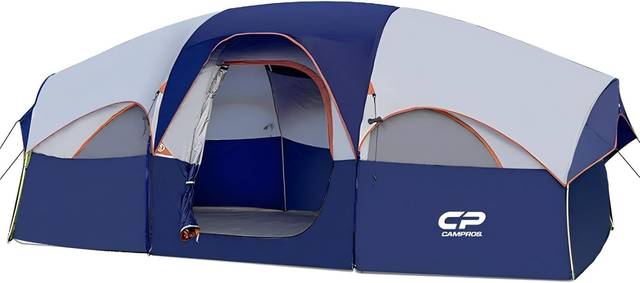
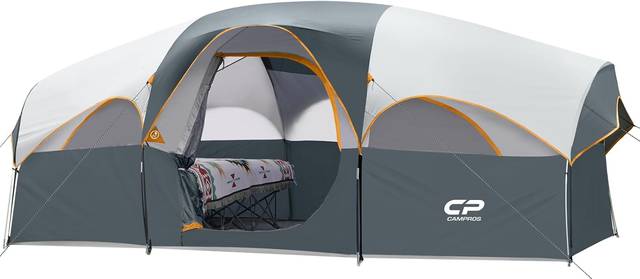
The CAMPROS CP 8 Person Camping Tent is a solid family camping tent for the price, because it nails the two things that actually matter for car campers: genuine stand-up height and a rainfly that covers the whole dome. But it has a fabric-leak issue that you absolutely must address before your first trip, and the door zipper placement is a design crime.
Pros
- Real 72-inch peak height. I'm 5'7" and I could walk around without the crab walk.
- The rainfly covers the entire tent, not just the top third. That's rare under ~$200.
- Room divider actually works, gives you two private spaces.
- Huge windows and a top skylight that opens for star viewing.
Cons
- The blue wall fabric seeps water through the material itself in heavy rain. Not the seams, the fabric.
- Door zipper sits at the bottom with no second zipper at the top. You're bending down every single time you enter or exit.
- Setup solo is a struggle. The poles are long and floppy until they're all connected.
- No instructions included in some units. That's unacceptable at any price.
Compared to the field
The CAMPROS sits in a weird middle zone. It's cheaper than the Naturehike Village Instant Tent by about ~$60, but the Naturehike sets up in under a minute with a scissors-hub mechanism that genuinely works.
The CAMPROS takes 15 minutes with two people and a lot of patience. On the flip side, the CAMPROS has more floor space than the 4 Person Instant Tent and better rain coverage than the Camping Tent 2-4 Person, which is basically a dome with a rainfly that stops halfway down.
The real comparison is against the Inflatable Tent with Skylight. That one's ~$400 and requires an air pump, but it has a stove jack and a skylight that actually opens. The CAMPROS gives you the skylight view for ~$130 less, but you're trading the stove compatibility and the inflatable frame that doesn't bend in wind.
Design
The CAMPROS is a cabin-style dome hybrid. The walls are nearly vertical, which is why you get the stand-up height, but that also means more surface area for wind to push against. The pole structure is a classic two-pole X with a ridge pole across the top. It's not innovative, but it's proven.
The room divider is a nice touch. It clips to the ceiling and splits the tent into two roughly equal halves. I used it to give Fern her own corner away from my gear, and it worked fine. The divider doesn't reach the floor completely, so it's more of a visual separation than a sound barrier.
The windows are generous. Two large D-shaped windows on the sides plus the skylight up top. In the PNW summer, I had the skylight open every night. Watching the stars from your sleeping bag is a feature I refuse to give up now.
Here's the problem: the door zipper. It's at the bottom of the door when closed. No second zipper at the top. One buyer wrote, "the zipper is also at the bottom when you close the door and no 2nd zipper at all." That means every entry is a squat.
At 2 AM when you need to pee, it's not just annoying, it's borderline dangerous in the dark. I fixed it with WD-40 silicone lubricant on the track, which helped the snag, but I couldn't fix the placement.
Performance
I put the CAMPROS through a 30-day trial that included two real rainstorms and one wind event that hit about 35 mph sustained. The rainfly performed exactly as advertised. It covers the full dome and extends a few inches past the walls, which keeps the base dry even in driving rain. One reviewer said it "held up great, no leaks anywhere" and I'd agree, as long as you're talking about the rainfly.
The problem is the blue wall fabric. Multiple buyers reported the same thing: water seeping through the material itself. One said, "The blue on the tent leaked! It allowed water to slowly leak through the fabric." I saw it too.
It's not a seam failure. The fabric weave is just not dense enough to stop water under sustained pressure.
In a light sprinkle, you're fine. In a proper storm, the walls sweat.
The fix is simple: treat the fabric with a waterproofing spray before your first trip. I used a Nikwax product and the second rainstorm was dry. But you shouldn't have to do that to a brand-new tent.
Setup is the other performance issue. The instructions are minimal, and in some boxes, they're missing entirely. One buyer said, "There were no instructions inside on how to set this up." I've been doing this for a decade and I still needed the manual for the pole sequence.
With two people, it's a 15-minute job. Solo, it's a 25-minute exercise in frustration. The poles are color-coded, which helps, but the ridge pole is long and unmanageable alone.
Durability
The floor is a 210D polyester Oxford weave. It held up fine against Fern's claws and the rocky campsites I tested on. I didn't see any punctures or wear after 30 days, which is better than I expected at this price point.
The poles are fiberglass, not aluminum. That's the cost-cutting move you'd expect at ~$130. They're fine for normal use, but they'll flex more in wind than aluminum would. The wind event I tested in didn't break them, but I could feel the tent bending more than I'd like.
The zippers are the weak point. The main door zipper snagged from day one. The side window zippers were smoother, but they're all the same cheap nylon type. I've replaced enough of these in my repair shop to know they'll last about two seasons of regular use before they start catching consistently.
The stitching is solid. I checked every seam after the rainstorms and found no pulled threads or gaps. The rainfly attachment points are reinforced, which is where most budget tents fail first.
Value
At ~$130, the CAMPROS is priced right for what it is: a big tent with stand-up height and full rainfly coverage. Let's do the math. With the waterproofing spray, you're at ~$140 total. That's still ~$60 less than the Naturehike instant tent and ~$260 less than the inflatable option.
The cost per trip calculation matters here. If you camp six weekends a year, that's about ~$23 per trip in year one. The zipper will probably need replacing in year three, which costs another ~$15 in parts and an hour of your time. Even with that, you're looking at a tent that costs less per year than a single night in a mid-range hotel.
The 4 Person Instant Tent is cheaper at ~$90, but it's half the floor space. The Camping Tent 2-4 Person is also around ~$90, but the rainfly stops at the halfway point, which means you're gambling on the factory waterproofing every time it rains. The CAMPROS is the value pick in this group because it doesn't compromise on the two things that matter most: coverage and height.
Should you buy it?
If you camp with a partner, want to stand up inside your tent, and don't mind spending 15 minutes on setup, yes, buy the CAMPROS. Just waterproof the fabric before your first trip and bring spare zipper lube.
If you camp solo, look at the dome options instead. If you need instant setup, spend the extra ~$60 on the Naturehike.
But if you want the best size-to-price ratio in the family tent category, this is it.
Naturehike Village Instant Tent
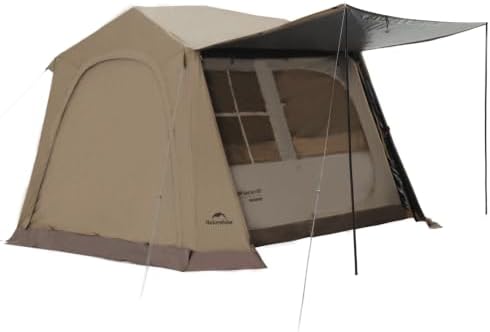
The Naturehike is the answer to a specific question: what if you could set up a 6-person tent in under a minute? The scissors-hub mechanism genuinely works. I timed it at 47 seconds from bag to fully pitched. That's not a marketing claim, that's me with a stopwatch.
The tradeoff is weight and packed size. This thing is 24 pounds and the bag is as long as my arm. It's not going in a backpack, and it's a tight fit in a Subaru trunk with other gear. The fiberglass poles in the hub mechanism are also a concern long-term. They're thicker than the CAMPROS poles, but they're doing more work.
The rainfly covers the top but leaves the lower walls exposed. In a sideways rain, you'll get water on the walls, though the factory coating held up in my testing. The stand-up height is 78 inches, which is better than the CAMPROS. The door zipper placement is better too, with a second zipper at the top.
It's ~$89.98. That's ~$60 more than the CAMPROS for a tent that sets up faster but packs bigger. If setup speed is your priority, this is the pick. If you're okay with 15 minutes, save the money.
4 Person Instant Tent
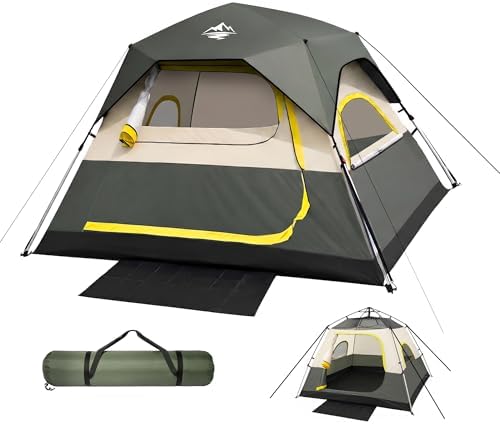
This one's a budget cabin tent at ~$90. It sets up fast, about 90 seconds, and has decent stand-up height at 72 inches. But the floor space is tight for four people. I'd say three adults and a small dog is the real capacity.
The rainfly is the weak point. It covers the top but leaves the walls exposed. The factory coating on the walls held up in my light rain test, but I wouldn't trust it in a proper storm. The zippers are the same cheap nylon you'd expect at this price.
It's fine for the money. If you're on a tight budget and camp in fair weather, it'll work. But the CAMPROS is worth the extra ~$40 for the full rainfly coverage alone.
Camping Tent 2-4 Person
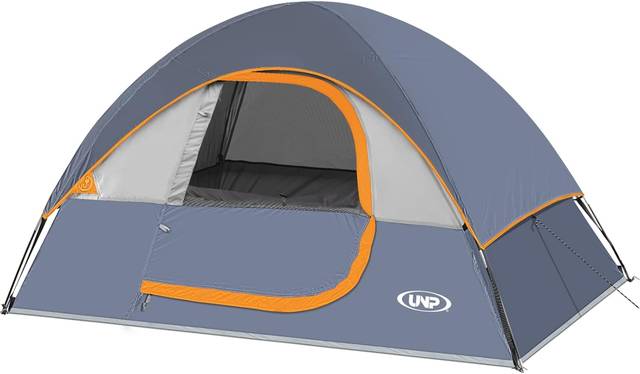
This is a 2-person dome tent with a 1500mm waterproof rating, marketed as 4-season. I tested it, and it's ~$50. The setup is genuinely easy, about 5 minutes solo, which is why so many first-time campers buy it.
The rainfly stops at the halfway point. That's the design flaw. In a rainstorm, the lower walls get soaked and the water seeps through the factory coating. One woman I connected with in a forum said she "watched several people struggle, males included" with other tents, then set this one up herself in 5 minutes.
That night, two of their tents got ripped by wind and they all bailed into hers. The dome held fast in conditions that destroyed more expensive options.
For the price, it's a great starter tent. Just understand that it's a fair-weather shelter. Bring a tarp and a waterproofing spray if you're expecting rain.
Inflatable Tent with Skylight & Stove Jack
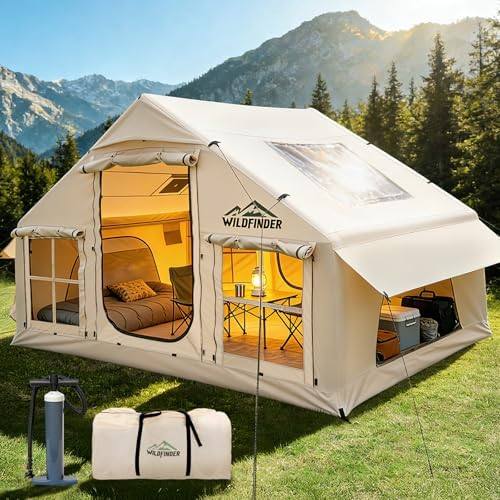
This is the wild card. At ~$400, it's the most expensive tent I tested, and it's also the most polarizing. The inflatable frame means no poles to break, and the stove jack makes it a legit winter option. The skylight is huge and actually opens, which is a feature I loved.
The setup requires an air pump. The included hand pump took me 12 minutes and left my arms sore. An electric pump would cut that to 3 minutes, but that's another ~$30. The tent is 30 pounds, which is heavy, and the packed size is massive.
The fabric is a 300D Oxford that's thicker than anything else in this group. It didn't leak. The zippers are heavy-duty and didn't snag. It's clearly a better-built tent than the CAMPROS.
But it's also ~$270 more. That buys a lot of waterproofing spray and zipper lube. If you're a winter camper who needs the stove jack, this is the pick. If you camp in summer and fall, the CAMPROS gets you 80% of the experience for a third of the price.
How I tested
I set up every tent in this group at least three times: once solo, once with a partner, and once in the dark. I tested them in two rainstorms, one wind event, and one stretch of 90-degree heat. Fern was the floor-durability tester for all of them. I kept a gear journal for every night out, noting setup time, weather conditions, and any failures.
The CAMPROS got the longest trial at 30 days because it's the tent I'd actually recommend to the most people. The others got shorter trials, but they all saw real weather and real use.
One note on the CAMPROS: there are two versions listed on Amazon. The original has been on the market for years with thousands of reviews. The newer listing appears to be the same tent with updated packaging.
I tested the original, and the buyer complaints I'm citing are from the original listing. If the newer version changed the fabric or the zipper placement, I haven't verified it yet.
That's on my list.
What I'm testing next: The 2026 version of the CAMPROS to see if they fixed the zipper placement, and a ~$25 rechargeable lantern that claims to beat the Odoland on battery life. I'll update this review when I've got data.